
How AI Is Changing SEO for Small Businesses in 2026
SEO is changing faster than most small businesses realize.
Ranking on Google was about:
keywords,
backlinks,
and publishing blog posts regularly.
Today, AI is changing how people search, and how businesses get discovered online.
For small businesses, this shift creates both a challenge and a huge opportunity.
Businesses that adapt early than competitors still using outdated SEO strategies.
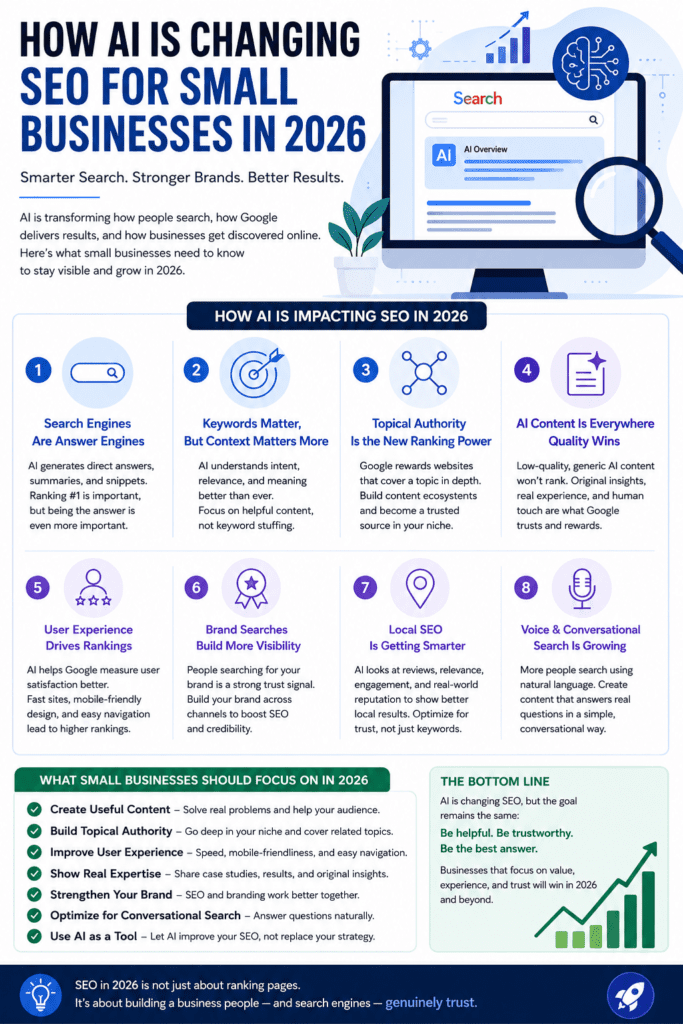
In this article, we’ll break down how AI is changing SEO in 2026
Search Engines Are Becoming Answer Engines
Traditional search worked like this:
A user searched for something.
Google showed a list of websites.
The user clicked a result.
Now AI-powered search is changing that experience.
Search engines increasingly provide direct answers instead of simply listing links.
Features like:
AI summaries,
featured snippets,
voice search,
and conversational search results
are reducing the number of clicks many websites receive.
This means ranking #1 alone is no longer enough.
Businesses now need content that helps search engines trust and reference them directly.
Keywords Still Matter — But Context Matters More
Many small businesses still focus heavily on keyword stuffing.
That strategy is becoming less effective every year.
AI-powered algorithms now understand:
search intent,
topic relevance,
user behavior,
and content quality much better than before.
For example:
Old SEO strategy:
Repeat “best dentist in Delhi” multiple times.
Modern SEO strategy:
Create useful content about the topic
Google’s AI systems are becoming better at understanding meaning than matching words.
That means businesses should focus more on:
helpful content,
clear expertise,
and user experience.
Topical Authority Is Becoming More Important
In 2026, search engines reward websites that consistently cover a topic in depth.
This is called topical authority.
For example, a fitness business might create content about:
fat loss,
workout plans,
nutrition,
recovery,
supplements,
and beginner fitness mistakes.
Google starts recognizing the website as a trusted source within that niche.
AI Content Is Everywhere — And That Changes the Game
AI tools now allow businesses to create content faster than ever.
But there’s a problem.
The internet is becoming flooded with generic AI-written articles that sound similar.
Search engines are adapting quickly.
Google increasingly favors content that demonstrates:
real experience,
original insights,
expert opinions,
and authentic information.
Businesses using AI effectively combine:
AI efficiency,
human editing,
personal experience,
and unique perspectives.
The future belongs to businesses that create content people actually trust.
User Experience Is Now a Major SEO Factor
AI is also helping search engines measure user satisfaction more accurately.
If users click your website and quickly leave, that sends negative signals.
Modern SEO is no longer just about attracting visitors.
It’s about creating a website experience people enjoy using.
Small businesses should focus on:
fast-loading websites,
mobile optimization,
clear navigation,
strong CTAs,
and trust-building design.
Even the best content can fail if the website experience feels outdated or confusing.
Brand Searches Are Becoming More Valuable
One major change in SEO is the growing importance of brand recognition.
Google increasingly trusts businesses people actively search for by name.
For example:
“Nike running shoes”
“HubSpot CRM”
“Ahrefs SEO tools”
These are branded searches.
Search engines see branded demand as a trust signal.
Small businesses can improve SEO by building stronger brand visibility through:
social media,
YouTube,
email marketing,
podcasts,
local communities,
and PR mentions.
SEO is no longer isolated from branding.
Today, brand authority directly influences search visibility.
Local SEO Is Becoming Smarter With AI
AI is also improving local search results.
Google now understands:
proximity,
customer reviews,
business relevance,
and user behavior
more accurately than before.
For local businesses, optimization goes beyond adding keywords to a Google Business Profile.
Businesses should focus on:
collecting authentic reviews,
updating business information regularly,
adding real photos,
publishing local content,
and improving customer engagement.
Local SEO in 2026 is heavily connected to trust and real-world reputation.
Voice Search and Conversational Queries Are Growing
More users now search using conversational language.
Instead of typing:
“best gym Delhi”
They might ask:
“What’s the best gym near me for weight loss coaching?”
AI-powered search understands natural language much better than older algorithms.
This changes how businesses should create content.
FAQ sections, conversational blog content, and educational pages are becoming more important.
SEO Is Becoming More Human Again
Ironically, AI is making SEO more human-focused.
Why?
Because search engines are trying to filter out low-quality automation.
That means businesses that show:
expertise,
authenticity,
transparency,
and trust
are more likely to succeed long term.
Small businesses actually have an advantage here.
Unlike large corporations, smaller brands can:
share personal experiences,
show behind-the-scenes content,
build community trust,
and create more authentic relationships with customers.
These human signals matter increasingly in AI-driven search.
What Small Businesses Should Focus on in 2026
Instead of chasing shortcuts, small businesses should focus on building long-term authority.
Here’s what matters most now:
1. Create Useful Content
Focus on solving real customer problems.
2. Build Topical Authority
Cover your niche deeply instead of publishing random articles.
3. Improve User Experience
Fast, mobile-friendly websites convert better and rank better.
4. Show Real Expertise
Use case studies, original insights, and real examples.
5. Strengthen Your Brand
SEO and branding now work together.
6. Optimize for Conversational Search
Write naturally and answer real questions.
7. Use AI as a Tool — Not a Replacement
AI should improve efficiency, not replace authenticity.
Final Thoughts
AI is transforming SEO faster than ever before.
But despite all the technology changes, the core goal remains the same:
Search engines want to recommend trustworthy, useful, and relevant businesses.
That means the businesses that win in 2026 won’t necessarily be the ones publishing the most content.
They’ll be the ones creating:
the best user experience,
the most helpful information,
and the strongest trust signals.
For small businesses, this is actually good news.
The future of SEO is no longer just about ranking pages.
It’s about building a business people — and search engines — genuinely trust.