
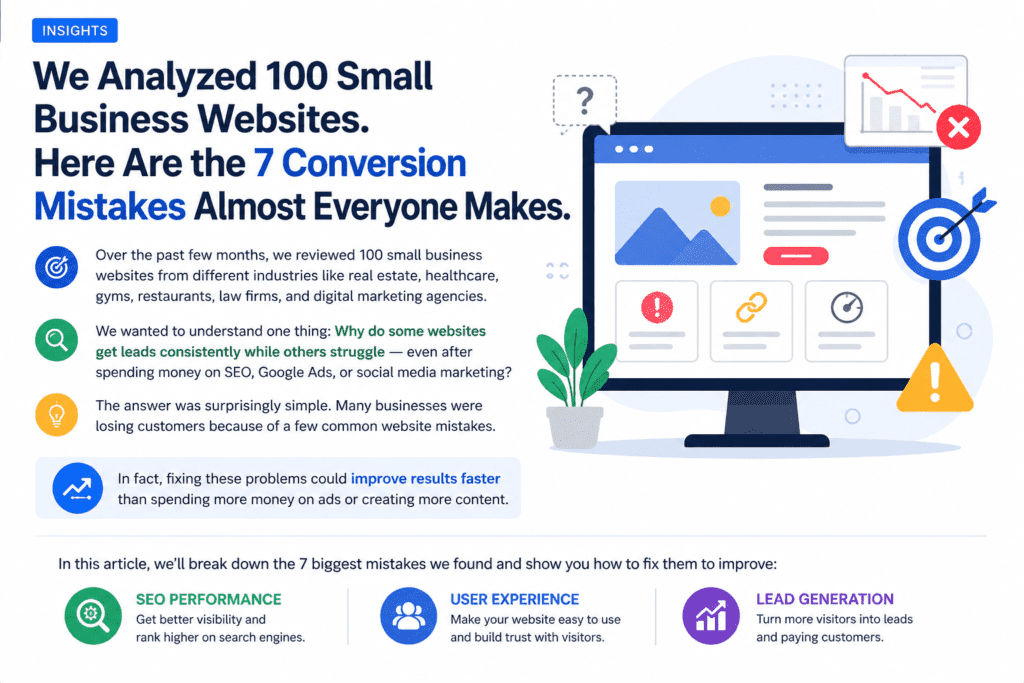
100 Small Business Websites — Here Are the 7 Conversion Mistakes Almost Everyone Makes
Most business websites don’t fail because of bad SEO.
They fail because visitors don’t trust them, understand them, or know what to do next.
The goal is simple:
Find the mistakes that stop websites from turning visitors into customers.
The results were surprisingly consistent.
The good news?
Most of these issues are easy to fix.
how businesses can improve them to increase leads, trust, and SEO performance.
Most small business owners believe they have a traffic problem.
In reality, many of them have a conversion problem.
Many businesses were losing customers because of a few common website mistakes.
In this article, we’ll break down the 7 biggest mistakes we found and show you how to fix them to improve:
- SEO performance
- user experience
- and lead generation.
1. Weak Headlines That Don’t Clearly Explain the Business
The headline is usually the first thing visitors see.
But many websites use generic phrases like:
“We Help Businesses Grow”
“Your Trusted Partner”
“Innovative Digital Solutions”
The problem?
These headlines sound professional, but they don’t explain:
what the business does,
who it helps,
or why someone should care.
Visitors make decisions fast.
If your homepage feels confusing, they leave.
What Works Better
Strong headlines are simple and specific.
Examples:
“SEO Services for Local Businesses”
“Custom Fitness Coaching for Busy Professionals”
“Affordable Accounting for Freelancers and Startups”
Clear messaging improves both:
user experience,
and keyword relevance for SEO.
2. No Clear Call-to-Action
A surprising number of websites never tell visitors what to do next.
Some hide their contact button. Others overload the page with too many options. And some don’t include a CTA at all.
That creates confusion.
Your website should guide visitors toward one clear action.
Common CTA Mistakes
Tiny buttons
Generic text like “Submit”
Multiple competing CTAs
Contact forms hidden at the bottom
Better CTA Examples
“Book a Free Consultation”
“Get a Free Website Audit”
“Request a Quote”
“Schedule a Demo”
The easier the next step feels, the higher your conversion rate usually becomes.
3. Slow Mobile Experience
More than half of web traffic now comes from mobile devices.
Yet many business websites still feel designed only for desktop users.
We repeatedly found:
slow-loading pages,
oversized images,
cluttered layouts,
annoying popups,
and difficult mobile navigation.
Users on mobile are impatient.
If your site feels slow or frustrating, they leave quickly.
Why Speed Matters
Website speed affects:
user experience,
conversions,
and SEO rankings.
Quick Fixes
Compress large images
Remove unnecessary plugins
Improve hosting
Simplify layouts
Use lightweight themes
4. Lack of Trust Signals
People buy from businesses they trust.
However, many websites give visitors no reason to feel confident.
One of the most common issues we noticed was the absence of social proof.
Missing Trust Elements
Customer testimonials
Reviews
Case studies
Client logos
Certifications
Real team photos
Media mentions
Without these elements, websites feel anonymous.
Why Trust Matters for SEO Too
Google increasingly prioritizes credibility and expertise.
This aligns with the concept of E-E-A-T:
Experience
Expertise
Authoritativeness
Trustworthiness
Websites demonstrating real expertise often perform better in competitive search results.
What High-Trust Websites Do Well
Successful websites show proof everywhere.
Instead of saying:
“We are experts.”
They demonstrate expertise through:
detailed case studies,
measurable results,
client feedback,
and educational content.
Trust is built visually and contextually.
5. Generic Content Created Only for Search Engines
Many businesses still publish low-quality SEO content filled with repetitive keywords.
This strategy no longer works effectively.
Modern SEO rewards useful, experience-driven content.
The Problem With Generic Articles
We analyzed dozens of blogs covering topics like:
“Top Digital Marketing Tips”
“Benefits of SEO”
“Why Social Media Matters”
Most of these articles offered nothing unique.
They sounded almost identical to thousands of other posts online.
What Google Wants Instead
Search engines increasingly favor:
original insights,
real experiences,
detailed examples,
and content demonstrating expertise.
Better Content Strategy
Instead of writing broad topics, businesses should create:
case studies,
industry observations,
local market insights,
original research,
or step-by-step tutorials.
For example:
Instead of:
“Benefits of SEO”
Write:
“How a Local Gym Increased Organic Leads by 62% in 90 Days.”
Specific content builds authority much faster.
6. Confusing Navigation Structures
Users should be able to find information quickly.
However, many websites overcomplicate navigation.
We found menus with:
too many categories,
unclear labels,
hidden pages,
and inconsistent structure.
Complex navigation creates friction.
Signs Your Navigation Needs Improvement
Visitors abandon pages quickly
Important pages receive low traffic
Contact pages are difficult to find
Mobile menus feel overwhelming
Simple Navigation Converts Better
Most high-performing websites use a clean structure:
Home
About
Services
Case Studies
Blog
Contact
Simple navigation helps both users and search engines understand the site hierarchy.
SEO Impact
Clear internal linking and logical structure improve crawlability, indexing, and user flow.
That contributes to stronger overall SEO performance.
7. Businesses Focus on Traffic Instead of Conversion Optimization
This was the most important pattern we discovered.
Many businesses are obsessed with increasing traffic while ignoring conversion optimization.
But traffic alone does not grow revenue.
What Smart Businesses Prioritize
Instead of chasing vanity metrics, successful companies focus on:
lead quality,
user intent,
conversion rates,
customer experience,
and trust building.
Conversion Optimization Often Delivers Faster ROI
In many cases, improving:
landing pages,
CTAs,
trust signals,
and mobile UX
can produce better results than publishing dozens of new blog posts.
SEO should not only bring visitors.
It should bring qualified visitors who are ready to take action.
Final Thoughts
After reviewing 100 small business websites, one thing became clear:
Most businesses do not need more traffic first.
They need better websites.
The good news is that many of these issues are fixable without massive budgets.
Simple improvements like:
clearer messaging,
stronger CTAs,
faster mobile performance,
and better trust signals
can significantly improve both conversions and SEO outcomes.
Search engines are evolving rapidly.
Today, ranking well is no longer just about keywords.